
Know when the machine is genuinely producing.
24 V MACHINE MONITORING
Give an older machine a live digital voice.
Start with two trustworthy signals—RUN state and finished-production count—then turn them into live status, downtime and production progress.
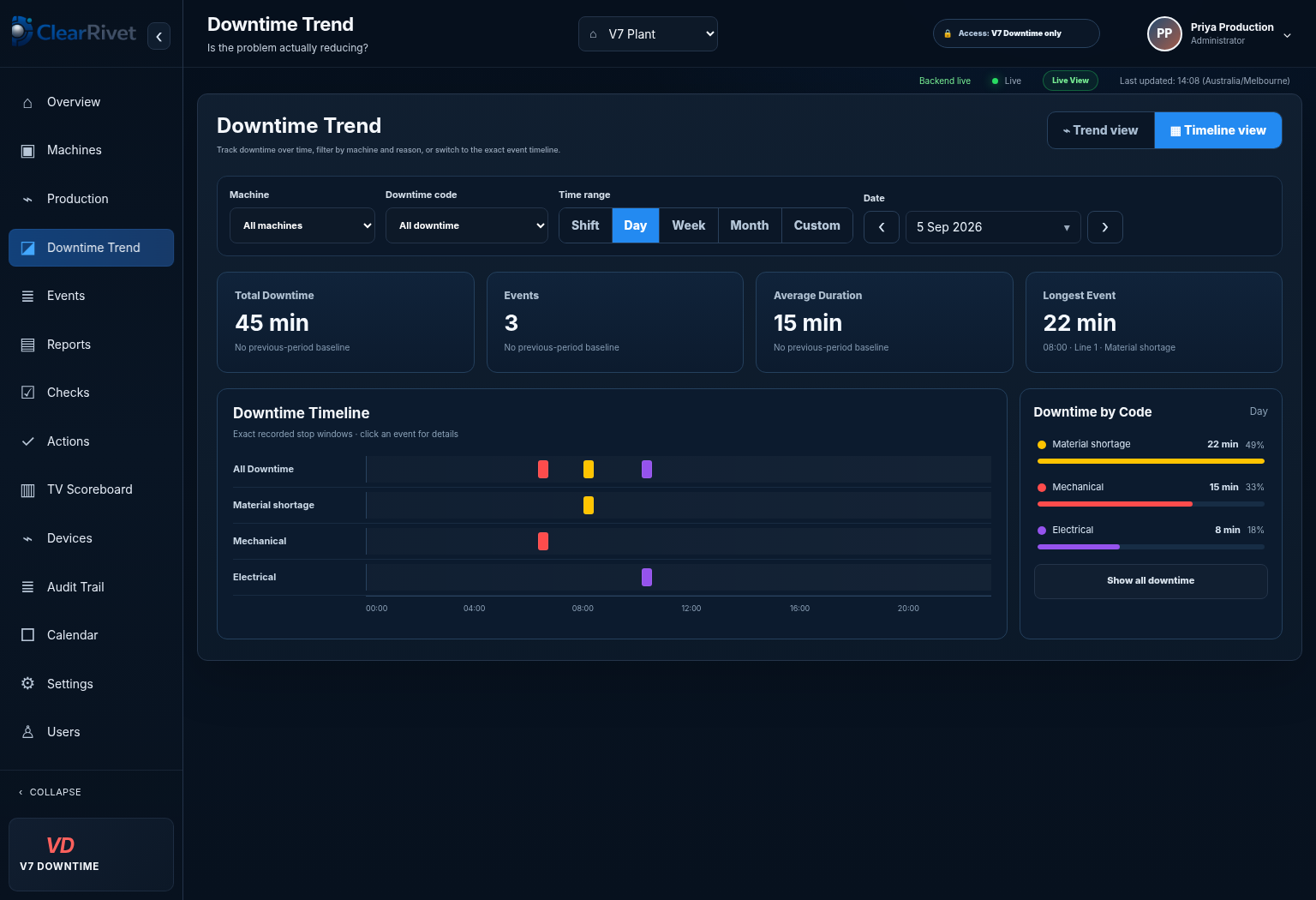
Actual ClearRivet UI: machine state changes become a usable production timeline.
THE STORY
Machine signal → trusted data → production visibility.
No MES replacement. No giant controls project. The first job is proving the signals are electrically safe and operationally meaningful.
Capture a reliable production pulse or count.
Test RUN, STOP and a known physical quantity.
See runtime, stops, output and OEE inputs.

WHAT YOU GET
Simple signals become useful operations data.
Once the machine state and count are proven, the team can work from a shared record instead of reconstructing the shift from memory.
Live running / stopped state
Production counts
Downtime events
Rate + OEE context
SAFE COMMISSIONING
Prove the machine before you trust the dashboard.
Use an approved isolated input path. Never connect unknown industrial or mains circuits directly to low-voltage computing hardware.
①Identify
②Isolate
③Run / stop test
④Known count test
⑤Live shift proof
EXPLORE THE WORKFLOW
From machine signal to production action.
COMMON QUESTIONS
Quick answers.
Can an older machine be monitored without replacing its PLC?
Often yes. Where suitable machine signals are available, isolated digital inputs can capture run state and production count without replacing the machine controls.
What are the minimum signals for useful production monitoring?
A practical starting point is a trustworthy RUN/state signal and a finished-production count. Additional signals can be added when they create a clear operational benefit.
Can 24 V be connected directly to low-voltage GPIO?
No. Industrial 24 V signals require a properly designed isolated interface or industrial digital-input module. Direct connection can damage low-voltage electronics and create unreliable or unsafe behaviour.
How do you prove the production count is correct?
Commissioning should include a controlled-count test: produce a known physical quantity and verify that the monitored count changes by the expected amount at real operating speed.
Start with one machine.